Joining UT Austin as Assistant Professor!
I am excited to share that I will be joining the Department of Computer Science at UT Austin as an Assistant Professor in Spring 2027, where I will be directing the ENACT Lab. I will also be a core faculty member at Texas Robotics.
Research
Robots are leaving the lab and entering homes, hospitals, and public spaces. For them to become a seamless part of everyday life, they need to act in ways people can readily interpret, and people need to express their goals in ways robots can understand. The ENACT Lab studies this mutual intelligibility: how people and robots build a shared understanding of each other, and how that understanding is established, maintained, and evolves over time. We build interactive robotic systems and the algorithms that power them, drawing on robot learning, foundation models, and interaction design, and test them with real people doing real tasks. Current directions include:
- Socially intelligent robots. Robots in the real world need to be socially intelligent, not just functionally competent. We are deploying robots in public spaces and developing algorithms that allow robots to build up knowledge from those interactions, such as asking people for navigational assistance. More broadly, building on our work on expressive behavior generation (GenEM), we are developing robots whose behavior is socially intelligent by design.
- Anticipating and recovering from breakdowns. Human-robot interactions are brittle, and breakdowns are inevitable. We address them across the lifecycle of interaction: tools that help robot designers surface failures before deployment, interfaces that robots generate on the fly such as to clarify ambiguous instructions during interaction, and new approaches for people to redirect and repair robot behavior as things go wrong, building on our work on instructing robots (ImageInThat, Grip-that-there).
- Intuitive teleoperation. Controlling robots remotely remains essential, whether for safety-critical tasks or for collecting data to train robot policies, but it is still cumbersome. We are exploring more direct and fluid forms of control, and how robot foundation models can make teleoperation intuitive and assist operators across tasks and environments, building on our work on teleoperation interfaces (Mimic, AeroHaptix).
Our long-term goal is not just robots that work in a lab study, but interactions that hold up in the real world, with everyday people, over time.
Join the lab
I am recruiting PhD students to start in Fall 2027. I am also looking for researchers and postdocs.
Specifically, I am seeking people with a background in robotics, HCI, or related fields who are excited about building and studying interactive robotic systems. Prior experience with hardware prototyping is a plus, but is not required.
If you’re interested in working with me, please fill out this form. Prospective PhD students should also apply to the CS graduate program at UT Austin and mention my name in their application. The deadline is December 15.
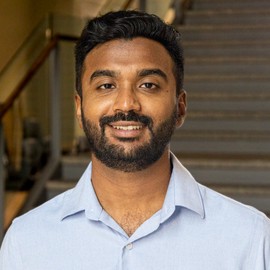
Karthik Mahadevan
Incoming Assistant Professor
I study human-robot interaction, building systems that help people and robots understand each other.